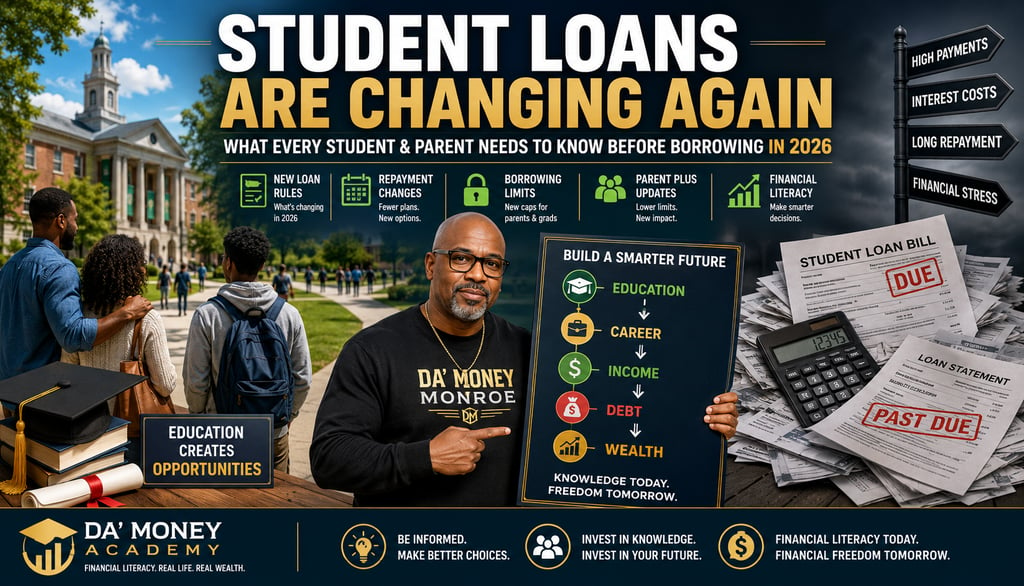
Student Loans Are Changing Again: What Every Student & Parent Needs to Know Before Borrowing in 2026
Student Loans Are Changing Again explores the major changes coming to federal student loans and what they mean for students, parents, and future graduates. From new repayment options and borrowing limits to the growing importance of financial literacy, Da' Money Academy breaks down the money lessons behind education financing and long-term wealth building. Because the goal isn't just getting approved for a loan—it's building a future where education, opportunity, and financial freedom work together.
My post content
Student Loans Are Changing Again: What Every Student and Parent Needs to Know Before Borrowing in 2026
By Da' Money Monroe | Da' Money Academy
For years, student loans have been one of the most discussed topics in personal finance. Some people view them as a pathway to opportunity, while others see them as a financial burden that can take decades to repay.
Now, major changes are coming to federal student loans in 2026, and students, parents, and families need to understand what these changes mean before signing any loan paperwork.
The rules of the game are changing.
The question is:
Are you prepared?
What's Changing?
Beginning in 2026, federal student loan programs will undergo significant changes affecting repayment options, borrowing limits, and future forgiveness opportunities.
Many of the repayment plans borrowers have become familiar with are being phased out or modified, while new borrowing restrictions are being introduced for parents and graduate students.
In short:
Borrowing may become more limited.
Repayment options may become simpler.
Future students may have fewer choices than previous generations.
The New Reality for Student Borrowers
One of the biggest changes involves repayment plans.
Future borrowers will generally have fewer repayment options and may be directed toward:
Repayment Assistance Plans (RAP)
These plans are designed to adjust payments based on income.
The goal is to help borrowers make manageable payments while still reducing loan balances over time.
Standard Repayment Plans
Borrowers may also choose traditional repayment schedules with fixed monthly payments over a set period of years.
While simple, these plans often result in higher monthly payments compared to income-driven repayment options.
New Limits for Parent Borrowers
Parents who use Parent PLUS Loans to help their children attend college may face new borrowing caps.
For many years, parents could borrow large amounts to cover education expenses.
Beginning in 2026, annual and lifetime borrowing limits will become more restrictive.
This means families may need to:
Save earlier
Apply for more scholarships
Explore alternative funding sources
Consider lower-cost education options
The days of unlimited borrowing may be coming to an end.
Graduate Students Face Changes Too
Graduate and professional students will also experience changes.
Some loan programs that previously allowed extensive borrowing may no longer be available to future borrowers.
This could impact students pursuing:
MBA programs
Law degrees
Medical school
Advanced graduate education
Future students may need to rely more heavily on savings, scholarships, employer tuition assistance, or alternative financing options.
The Question Nobody Asks
Most people focus on one question:
"Can I get approved for the loan?"
The better question is:
"Should I borrow this amount?"
Just because money is available does not automatically make it a good financial decision.
Before taking on student debt, consider:
Expected Income
What is the realistic salary for your chosen career?
Not the best-case scenario.
The realistic scenario.
Job Demand
Are employers actively hiring in your field?
What does the next ten years look like?
Return on Investment
If you borrow $80,000 and your degree helps you earn $30,000 more per year, that may be a worthwhile investment.
If you borrow $80,000 and your income remains unchanged, the math becomes much more difficult.
Opportunity Cost
Could a certification, trade school, apprenticeship, community college, military service, or employer-sponsored training provide a similar outcome at a lower cost?
These are questions every family should ask.
Education Is Still Valuable
Let's be clear.
Education is not the problem.
Knowledge remains one of the most valuable assets a person can acquire.
The challenge is making sure the cost of obtaining that knowledge makes financial sense.
Education should help create opportunities.
It should not become a financial anchor that limits future choices.
The Da' Money Perspective
At Da' Money Academy, we believe financial literacy should come before financial obligations.
Before signing any loan agreement, students and parents should understand:
How interest works
How repayment works
How long repayment may take
The true cost of borrowing
The earning potential of their chosen path
Student loans are tools.
Like any tool, they can help build something valuable when used wisely.
But every investment deserves careful evaluation before money is committed.
The goal is not simply to attend college.
The goal is to create a future where education, income, opportunity, and financial freedom work together.
Because the smartest financial decision is not always the one that gets you approved.
It's the one that helps you build lasting wealth.
About Da' Money Academy
Da' Money Academy helps individuals and families better understand money, investing, entrepreneurship, wealth-building, and financial literacy through practical education and real-world insights.
Explore free courses and financial education resources at:
https://shop.da-money.com/courses
Financial literacy today. Financial freedom tomorrow.
Unlock your Wealth Blueprint — enter your email to get started.

Master Money Daily
© 2026 da' Money. All Rights Reserved